El Gringoqueño

All a man needs out of life is a place to sit ‘n’ spit in the fire.

Page 30 of 51

Some Unaware of King’s Dream

WP: Some unaware of King’s dream – washingtonpost.com Highlights – MSNBC.com

I’ve said it before ( In Observance of Martin Luther King Jr. Day ), but it seems to bear repeating.

Last night, I was at a party and one of the party goers, an American, mentioned that he had to leave.

"Oh, the party’s just getting started," I offered, hope to cajole him into staying.

"I have to get up at 4:30."

"You have to work tomorrow?! What? They are making you work on the birthday on one of the greatest Americans who ever lived?"

"Who might that be?" he asked with a frown.

"Um, Dr. Martin Luther King Jr.," I replied, not sure what he was getting at.

He smirked, "Oh, him."

I was unsure if I had just experienced a racist moment. I suspect I had.

Translations: Christian-Speak to Science-Speak

Biological and language variations are constants of the human condition. As we walk this earth and congregate, language tends to change and evolve at the same time it holds onto pieces at its core. Language becomes a venue ripe for misunderstandings. In our complicated and segregated modern life, it is easy to live in a city with 7 million people, speak the same language and yet not understand our neighbor. There is an ever growing need to pay attention to the variations in language styles. The economy of speech creeps in to facilitate conversation between parties that share common experiences. Whether we are hanging out on the corner, working in a deli, or at a physics lab, we each easily dominate many language styles. Our days are full of examples of heteroglossia, and yet strangers meet and think they understand each other. Inevitably though, there is a "you people!" and "but you said!" Our expressions vary and our differences seem insurmountable.

I believe a handy translation would save us from unnecessary strife and aggression.

  1. Christian-speak: God has a plan for your life.

    Science-speak translation: Your unique set of circumstances including DNA, talents, upbringing, and environment, have the possibility of an optimal outcome. It is up to you to figure out for which optimal lifepath you are suited. All others are suboptimal although not necessarily wrong.

  2. Christian-speak: Accept Jesus Christ as your personal savior.

    Science-speak translation: The cosmos or universe or some first-cause event has yielded a sequence of steps all of which have lead to your existence. We don’t care why, it is irrelevant for the purposes of this problem set. What we do know is that all your ancestors, all past life has lead up to you since the beginning of time. Does that humble you in any way? Great! Now you need to open yourself and listen. Read #3 for further explanation.

  3. Christian-speak: Jesus died for your sins.

    Science-speak translation: I’m just saying, don’t let imprecision or uncertainty get in the way of
    living. Rather than scrape and claw at the multitudes of things that go
    wrong, are imprecise, or flawed in some way, just try to make what you
    have better. Make sure your general tendency is toward justice. It’s a
    sort of asymptotic function whose limit is perfection. Rather than
    focus on the impeccable (from the Latin, meaning without sin), just go
    ahead and round to a reasonable figure based on the task at hand.

    Look, we live in a world where there is no perfection. That is, like the Heisenberg uncertainty principle, you can measure a particle’s momentum or position but the more precise you are about one, the less you know about the other. Life’s not perfect, get over it. You deal with what you have. So, with that said, imperfection is your natural state of being and death will come to you. Those are our boundary conditions. They contain the meat of the problem at hand, which is: How do you live the intervening space time.

    What about the rest? Well, the Prof said not to worry about them, because they don’t matter.

More translations to come, as I think of them. Perhaps a science-speak translation would be in order too, I dunno.

Laura’s Books Finally Have a Home

Santa Claus brought Laura two wall-mounted bookcases to house her extravagant book collection. It wasn’t too hard to build them. Let me rephrase.

It wasn’t too complicated to build them.

Building two bookcases was hard. But I had fun, and I got back in touch with woodworking (even if it was pretty basic).

Here’s how it went. First, a neat picture that doesn’t really showcase the finished product, but I like the photo, so it goes first. See the bookcase in the background? Look, there’s a Christmas Spider-man in the front. Neat.

Bookcase_0022.jpg

Here’s the finished product, two simple laminated bookcases, 13 inches deep by 24 inches wide and 48 inches tall.
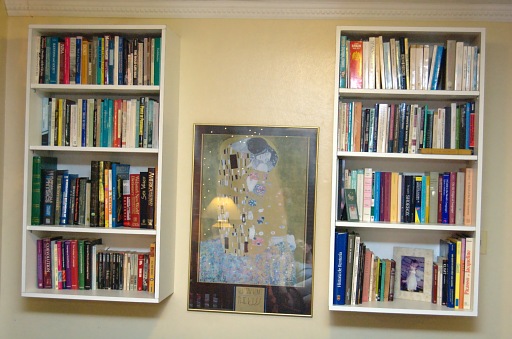
Bookcase_0016.jpg

My first step was to draw up a little design in qcad. Here’s a PDF of the file as well as a DXF for import into a wide range of vector/CAD drawing programs.

Next, just to see how the things would look in the space I had, I rendered them out in POV-ray complete with a subroutine of random books. Download the source.

BookCase_pov.jpg

With all the theoretical stuff done, the only thing left was to build the thing. Should be simple.

Yeah, right.

Day One

I took my measurements to the lumber yard ordered two 48×96 inch pieces of plywood, had the guys cut them up for me ($2 per cut), bought some self tapping anchor bolts (walls are concrete in Puerto Rico), some 1 3/4" #10 wood screws, some contact cement (for gluing the laminate), and four sheets of white laminate @ $10 apiece. All total, it came out to $150 (which would, of course, go up later… but that’s coming).

First thing I did was assemble the wood into its final shape to make sure the cuts were correct. Everything came out perfectly. When possible, let your local lumber yard do your cuts for you. It would be a pure luxury to have such a great, high speed, powerful table saw. A man can dream can’t he?

With the box assembled and checked, I rested on my laurels and did not do another thing that day. I KNEW what was coming, and I wanted to savor my small success.

Day Two

Let’s cut and glue some laminate, shall we? I’ve never done this before, but the directions sounded easy enough, use your utility knife to score the laminate, then carefully break it along the perforation. Check. Except, I kept tearing it. My perforations were uneven, not deep enough, or would veer off at the worse possible moment. Sigh. I salvaged what I could and quit for a few hours, resigned to the fact that I would have to buy more laminate. Perhaps the sweat dripping from my brow was causing me to rush.

A couple hours later, I rejoined the battle. I successfully cut a few small pieces of laminate. I shall now glue them. Cue the blood red sticky brain cell killing noxious contact cement. Horrible stuff! Good thing I was doing it outside where there was a nice breeze… and – drops of rain. D’oh. I scrambled in with my tools and glue covered panels sticking to my arms.
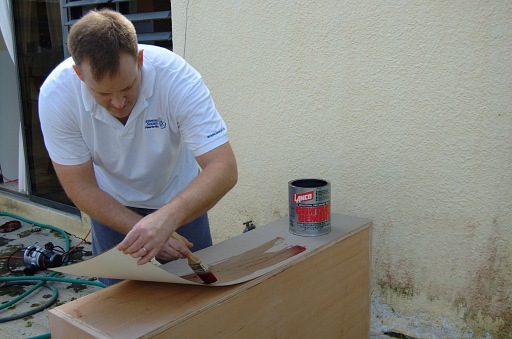
2006_Familia_Gorbea_Party_0007.jpg

After a half hour of drying, I was ready to press the panels together. SUCCESS! The glue held well, and I trimmed off the excess with my router’s laminate trimmer and all was well. I ran back and forth because of the rain a couple times and managed to glue two or three complete panels.

I should mention, however, as a precaution, a caveat if you will, that upon later examination, I noticed the red stuff all over my hands, arms, and legs was not, in fact, entirely glue. Some of it was blood, drawn by the fine slicing edge of the fresh cut samurai laminate. A mighty warrior he was, for his blade was NOT dull. It was razor sharp upon the edges where it was cut. I had learned of the master’s skill the hard way. Day three would feature me with multiple bandages.

Day two also contained a mishap that is only amusing in hindsight. Content with my assembly and swelled with pride at my modest accomplishment, I left the assembled box in the middle of the family room floor that night. I stepped out to put the house to bed, admired my handiwork, put the doggies in their houses, closed the doors, turned off the fans and lights, grabbed my bottle of water, and strode toward the bedroom.

The fall was not even registered. I was simply and abruptly crushed into the box. Yeeaaii, ouch, &#(%& (this is a family blog afterall). Was this what soldiers who fell into booby traps in Vietnam felt like? OMFG, it hurt. I had flayed the skin from my shins, forearms, and where my wristwatch had caught the edge and dug deep, the skin had already started to swell.

Luckily, copious quantities of ice saved me from a week of misery, but at the end of day two I recounted:

  1. Blood – Check
  2. Sweat – Check
  3. Tears – Check

Things were going smashingly. We’re right on schedule.

Day Three

Day three was more of the same, more cuts, more blood, more cursing, more lifting, moving and avoiding the rain. Glued a few more panels, made a few mistakes. I was approaching something resembling a finished product.

Day Four

After four days, I had finally done it. I had constructed a box!
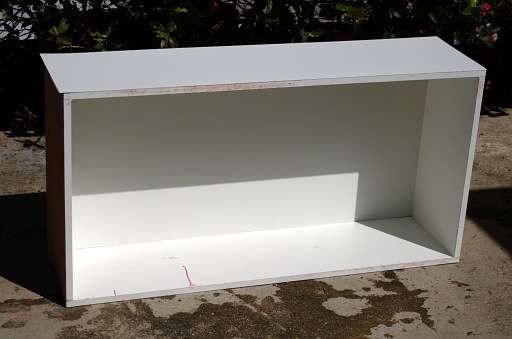
2006_Familia_Gorbea_Party_0002.jpg

Feel my power! The box had two sturdy sides, a top, a bottom, and a back and was laminated inside and out. Yeay! Now I’ll need to do the shelves. Uggh!

Day Five

Suffice it to say, there are no more days. It only took five days. By 2 am, it was on the wall and loaded with books.

Bookcase_0006.jpg

"It looks great, Jim," my ever supportive wife remarked. "Now all you have to do is make the other one."

Day Six

Guess what? The second bookcase only took a day and a half. How’s that for a learning curve. I developed a technique for cutting the laminate. I got the gluing down to a science. Measuring, drilling, pressing, etc., all went a lot easier the second time around. Stuff that seemed irritatingly awkward, now went off without a hitch.  I guess it’s like that with everything.  I’m just happy I got to build something and I got away from the computer for a spell.

Cool.

Bookcase_0020.jpg

"That’s great, Jim," cheered Laura, "Now you can redo the bathroom cabinets."
Societal Toxicity

I was watching CNN this afternoon. Featured was a young Palestinian-American living in Gaza.

"What’s it like?" the CNN reporter asked him. "Are you scared." She furrowed her brow with concern.

"It’s tough sometimes," the young man said with nary an accent, his skateboard dangling limply at his side, shoulders slack. "Yo, my buddy was almost blown up. It was like, messed up an’ stuff. This rocket, like, it came screaming in and almost hit us. Yo." We, the viewer, are treated to a little montage of our youthful ghetto urban kid from the "street" yo doing lame jumps around Gaza on his skateboard.

Then his mother comes on, Shelly "American Name hyphen Palestinian name." "I worry about him. It is dangerous here. But what are you going to do?"

And I’m thinkin’, GET THE HELL OUT OF GAZA, IDIOT! So here we have an American woman married to a Palestinian man, and the best living arrangement they could come up with was Gaza? WTF?

So okay, I’m thinking, benefit of the doubt time. Maybe they are international aid workers. Maybe he is well-educated and has a call to social work and civil justice. He cares about his people and wants to help them.

But then I thought about Chernobyl.

Yeah, Chernobyl.

Would you raise your kids there?

There’s a toxicity in the ground, in the air, in the water that isn’t going to dissipate for hundreds of years. The best thing you can do is leave. Barring that, you die. This is the same scenario for any one of the US Federal Superfund sites, communities laid to waste by greed, incompetence or ignorance. Guess what happens, folks. People pack it in and head for the hills. The ground’s been spoiled. The land isn’t worth having. It sucks, but we’d rather be alive someplace else then die young from non-Hodgkin’s lymphoma or have our kids born retarded and/or with missing or extra digits.

So it makes perfect sense to leave. You do not want to raise your kids in a toxic environment because it will make them sick and they will suffer and die.

You do not want to raise your children in an environment of violence, hatred, and poverty because it will make them sick and they will suffer and die. Living in such a place will make you just as sick as if it was pesticides, mercury, or uranium.

Why do we have so little insight into societal toxicity? What happens when a culture, region, or neighborhood is so overwhelmed with hatred, violence, crime, and oppression that it becomes impossible to grow up healthy and unaffected by the mutagenic qualities of the environment? Why do we as stubborn idiot humans feel some sort of social responsibility to the land and/or the community? How come the help we feel we need to render is something other than a ride out of the place?

An environmental worker explains, holding an intricate cylindrical device connected to a number of brightly colored tubes, "You see, resident, we just need to filter the water through this special radiological filter – don’t forget to change it every 3 months *nervous laugh*, and make sure that you don’t go outside without your dust mask. And don’t touch the dirt. Oh, yeah, you can’t hunt either. All animal life is carrying alpha emitters. Oh, yeah, make sure you sleep face down with a sheet over your head and put tape over all points in your home where there is air infiltration: door jam, windows, etc."

"Um, miss, we just want to leave. Can we go someplace else?"

"Why would you want to do that. This is YOUR land."

"Yeah, but my, um, urine glows."

"Who’s a mister negative. You just have to make it better. Where’s your sense of responsibility?"

"It left with my hair."

So you see it doesn’t make any sense in Chernobyl, why should it make any more sense in Palestine, the favelas in Brazil, La Perla in Puerto Rico, North St. Louis, or Iraq, or any place else that has been spoiled completely by societal toxicity.

Get out, get far away, let the half life of hate and despair take its toll on the area. Let it return to its placid state. Once the haters have killed each other, you might be able to move back and reclaim the land, but it’s going to be a long time. Don’t expect it in your lifetime. All forms of toxicity take generations to dissipate, hate included.

Why the Military Doesn’t Want More Troops in Iraq

Well, actually they do want more troops in Iraq, but it’s just that commanders want so many more, that another 30,000 may as well be zero. The problem once again is rhetoric. Military commanders are loudly sounding off that they do not want more troops in Iraq. How does this reconcile with claims by these same military commanders and analysts that we went in with too few troops?

Observe this behind closed doors exchange with the Decider:

Bush: How many more do you boys need to pacify Iraq?  I’m all ears and willing to do what it takes to go forward.

Commander: 300,000 minimum. We coulda done it with less going in, but now we’re going to need to ramp up to 500,000 to get the job done.

Bush: Hmmm, I hear ya.  I hear ya, but I can only spare you 30,000. 30,000 more is all the political capital I have to spend. Politics won’t allow me to send more than 30,000. Ya see, that number 30,000? It’s all I can send.  I’ve decided.

Commander: Well then you can keep ’em. Don’t send ANY then. 30,000 is like zero – exactly like zero, except that there are going to be more bodies sent home. Casualties will increase with zero increase in effectiveness.

Bush: Son, listen, this is politics. You just be a good soldier and put these boys to good use in the war on terror, guarding Haliburton facilities, etc. We’re going to win, you hear! I’ve decided it!

Commander: Whatever you say, sir. *salutes leaves*

How to Win the War in Al Anbar

Chris Penningroth’s Weltanschauung » A Short Memorial to Two Fallen Brothers

Chris has a memorial post up about CPT Travis Patriquin.  I didn’t know the guy, but as I read more of the links and got to his now famous powerpoint presentation, I was blown away.  We need to listen to this guy.  Forget the Iraq Study Group’s recommendations and just look at this dead simple document about what needs to be done.  I don’t doubt that CPT Patriquin understood the subject matter.  As one of perhaps the only fluent Arabic speakers on the ground, his recommendations hit home with the simplicity of a subject perfectly understood.

What I Learned Tonight from a Bunch of Juvenile Offenders

No disrespect there, I assure you.  I just want to set it up properly.  I’m a college educated professional, with a background in Art, Technology, Engineering and ample business and life experience.  

But tonight, I felt insignificant, shamed, and incarcerated as I was within my own limits.

Tonight’s activity in the prison was to design Christmas cards.  We gave the young men paper, crayons, and color pencils and asked them to draw Christmas cards.  I offered that they should draw something they knew or draw something in which they were interested.  "What do you have to say?" I asked.

They busily set forth with religious iconery, scenes of nativity, presents, Christmas cheer, cars, Santa Claus and the like.

I sat with my paper blank with my head in my hands. 

I had nothing to say.  I’m not into blindly recreating religious themes.  As an American Catholic, I more resemble a Protestant, indifferent to the rendering of religious symbols.  Drawing a baby Jesus doesn’t come naturally to me.  Virgin Mary?  You kidding?  Three wise men?  Maybe, but it wasn’t coming.  Could I draw a camel?  I don’t think I’ve ever looked at one closely enough.  I thought about as many different Christmas or Puerto Rico images I could and rejected them – each and every one.

I was afraid what I had to say was not worth saying, that my drawing would suck, or be irrelevant.  I sat paralyzed by indecision and apprehension.  The more I sat, the worse it got.  I’m an artist.  I still look at some of my charcoals and think, "Damn I was good."  But today and recently… I just don’t know.

And these kids, disadvantaged, without the love of their parents or stable communities, and locked up as they were, happily drew whatever their hearts told them.  To quote Satchel Paige  "…dance like no one is watching." 

They did.  I couldn’t.

They seemed freer to me somehow.

Star Trek: A Bunch of Superstitious Calvinists

Yeah, you heard me right. Oh sure, Picard and his lot are all: "Some people believe in a higher power, but we here in the 24th century believe in the power of our human compassion, will, and nobility."

Bah! I say to you, Jean-Luc Picard. Bah! I say to you, Gene Roddenberry. Bah! I say to you, Rick Berman.

Two words: Prime Directive.

If that’s not belief in God, I don’t know what is. And it’s not just any God, but a Puritanical micromanaging control freak who’s already decided everything that will ever be decided.

Who came up with that Prime Directive shit anyway? Oh, I’m sorry, I can’t help you because it might affect some future event in a way such that it will not transpire in the natural (read: pre-destined) fashion. WTF? Is the future Federation a bunch of cowering Calvinists with their pre-destination crap?

I mean, really people, how did this escape unanswered for so long? Star Trek fans will go long and hard for the Prime Directive, that it’s somehow pure, clean, unencumbered by our messy superstitions, organized religion, God.

Look how advanced we are in the future, they say. That future is something for which to strive.

I suppose we look to that Prime Directive as some sort of ideal simply because we’ve seen how self-interested intervention in the affairs of other nations has ripped them apart and fomented so much suffering. The twentieth century, for example, is littered with meddling gone bad. Vietnam, possibly the crucible in which the Prime Directive was formed, is perhaps the best reason for its creation.

Then there’s the model of Switzerland, the model of, "Well, if you were meant to live, you will live. If you were meant to die, you will die. I cannot interfere." This Prime Directive of neutrality has somehow been held up as the ideal of behavior. We hold inaction as the highest morality. Do nothing, speak nothing, hear nothing, and all will cruise along at His will.

Don’t you see how loony it all is, you bunch of superstitious Calvinist freaks? We were not put here to play our parts in God’s little Broadway production, thank you very much. We were put here for, and only for, to live, to choose, to learn, and to love.

The noblest of all possible courses of action is not to withdraw, back away, and let it all transpire by some unseen hand. No, our best hope is to act in the best way that we know how with the information we have at moment. If a stranger needs a hand, we help him and damn the supposed later consequences. We don’t know much, and we can’t rely on God to push it all along like some divine universal machine.

Life is messy. We make choices. We make mistakes. We fail. We succeed.

What sort of world or universe would accept us into its cradle where we impacted nothing, did nothing, took no stock of our surroundings, and did not act as if we were the masters of our destiny.

No, Star Trek people, the Prime Directive is NOT good and noble. The Prime Directive is at best a "Hope for good but do not interfere" and at worst, a retreat from the universe of flesh and blood.

You may as well have not existed.

What if it’s not just incompetence?

Recent changes in the tax code of Puerto Rico have caused me to rethink a long held opinion about the nature of our politicians. The Jenius, over at his blog, rightly predicts that the underground economy in Puerto Rico will perfect itself as taxation wriggles into all legitimate economic transactions. Small micro companies will just take what little business they have further underground away from the grabbing hands of government, and more of them will do it better.

Medium-sized brick and mortar shops will either shoulder the burden or pass the cost on to the customer. Either way with rising prices, already pinched consumers will be forced to buy from the lowest supplier, those 800 pound gorillas with their cheap global supply chains and volume discounts. If small business owners try to compete on price their already compromised position further erodes to the point of survival mode. They are then either pushed into gray areas of the underground economy or out of business entirely.

The big global players are already earning money hand over fist, and if their position is eroded only slightly by rising consumption taxes, they have a number of options. They can negotiate tax breaks for their local hiring, get government handouts to build new facilities, low interest loans, you name it. They have the clout and the cash to get what they want, whether it be cheap goods, cheaper labor, or cheap government.

So where does that leave us?

I always thought that bad government policies through incompetence or malice had an effect to drive out entrepreneurial spirit, to foment low level corruption, and give unfair advantage to large imported global players (pharmaceutical manufacturers, retailers, fast food, national chains etc). But now I’m notso sure it’s incompetence or even malice.

What if their aim is to kill off the last of the local companies for us, as a favor to pacify us and give us jobs, to give us what we want, to work for the man, and play on the weekends, to be kept, taken care of, and have no responsibilities? Maybe these politicians know something we don’t want to admit or care to face:

We want to be kept and taken care of.

We would rather work for Wal-mart than try to start our own business, and the best to which we can hope to rise, the pinnacle, the ultimate, is to be a general manager in someone else’s plant, to be validated by the higher power the foreign national, the colonial overlord.

I hope it’s just incompetence… although at this point I’d even take malice.

Please tell me I’m wrong, please Puerto Rico?  Tell me it’s not what we want.

My First Forays into Typesetting with Latex

I’ve been busy copy-editing and typesetting Laura’s doctoral dissertation. I’ve always been a fan of Donald Knuth and his obsessive work in typesetting with Tex. Since my beloved wife is a Stanford Student, I figured, cool, I’ll use TeTex (Latex) to publish the thing, kinda like an homage to the their text publishing tradition. Also to thumb my nose at the Computer Science graduate students who don’t think anyone outside of their department uses TeTex/Latex. They provide a Microsoft Word Template for the rest of the school. Screw that.

Latex is not for the faint of heart, though. The text markup language has a pretty steep learning curve, but once you get the hang of it, you won’t know how you lived without it.

First: Here is what you get with a Latex source document.

  • Auto generated/indexed/enumerated list of tables and figures, complete with hyperlinks (in the PDF generated version) to their appropriate section
  • All the enumeration happens regardless of where the table is. You cross reference based on a reference flag, not text. So for example, you don’t write out, "see table 2.1" you just create a label to your table like so, giving it a human readable name (although it could be anything):

    \caption{\label{tab:Articles-with-Language}
    Articles with Language as Subject}

    and then you reference your table like this:

    The high percentage of articles on Language present
    in this local news section in contrast to a
    low percentage on Education (Table \ref{tab:Articles-with-Language})

    You never have to remember what table or figure number goes where with what table or chapter or whatever. You also don’t have to manually update your list of tables or figures. This lets the researcher get to the business of writing their paper rather than screwing around with formatting, which, let’s be honest, occupies a vastly disproportionate amount of the researcher’s time.

  • Benevolent Stanford students have graciously provided a complete thesis Latex style to take care of formatting for print/ebook publication. Even/Odd margin stuff is taken care of for you. Smart beautiful justification and hyphenation, footnoting, contents, etc is formated and beautifully handled.
  • Laura gets to write her stuff in OpenOffice, export it to Latex and I then format with Stanford’s thesis style sheet.

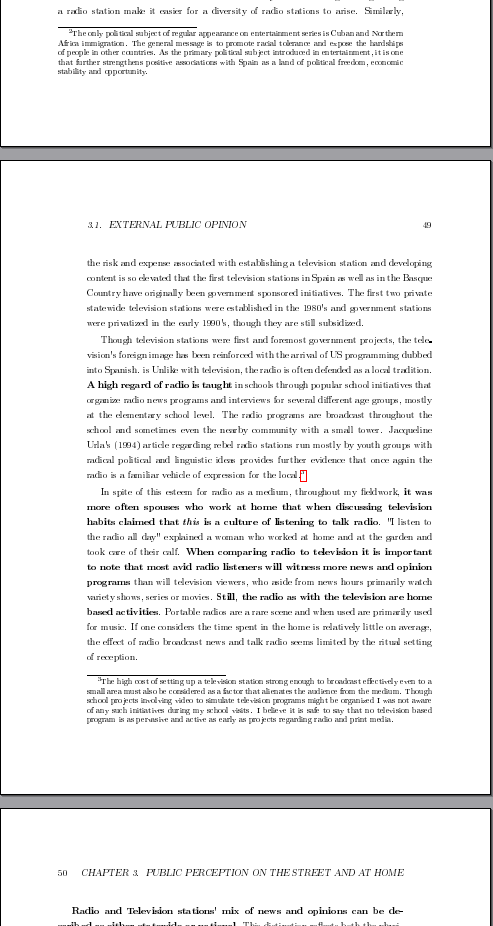
Here’s what it looks like:

screenshot.png

Now that I’ve gotten into this a bit, I’m addicted. I’ve seen how other people have published ebooks and to tell you the truth, they get them pretty wrong. There is no cross referencing, no hyperlinks to the sections, no footnote links, table links etc. In addition, with Lyx (frontend editor to Latex) you get to separate out your chapters, sections etc and have multiple people work on or copy edit at the same time. Since each is but a text file, you can use a source code versioning system like Subversion or CVS to track changes. This allows you to publish tight updated versions and divide up the work.

I highly recommend Lyx, Latex for any sort of professional publishing. It’s makes maintaining long documents of any sort simply a breeze.

« Older posts Newer posts »

© 2026 El Gringoqueño

Theme by Anders NorenUp ↑