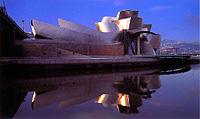
 I’m not sure just how much you know about this magnificent building,
but it was recently finished under much international pomp and
circumstance. The Guggenheim in New York sought and found a city that
would undertake the newest task of supplying a location worthy of
housing the greatest modern art treasures of the world.
That city was Bilbo, Euskadi (BILL-bo, eww-SKA-dee) (Basque spelling of
"Bilbao" (BILL-bow) as in bow wow (dog bark)). In a city still trying
to overcome the difficult times of industrialization and civil war,
civil strife, and national identity, it is difficult to imagine what
the Guggenheim means to them. It is certainly a mark of national pride.
Critics in the community of Basque artists are quick to point out that
the museum is nothing more than an American icon dropped like a big
golden arch on top of an already repressed culture… call it McArt.
Whatever the case, it has brought a lot of attention to a city that is
trying to define itself apart from Spain and Spanish notoriety. They
have done it by building the building that was said to be unbuildable.
Basque engineers and contractors designed many firsts, from types of
I-beams to special suspension techniques to pull off a great coup for
the Basque People.
So we went through the galleries, as of now not that great a
collection, but it’s getting there. Once they (Guggenheim) get beyond
the dumping of art from their basement in New York to fill space here,
and start putting together a unique collection that has a personality
all of its own, then we’ll see some great things from Bilbao. I have to
say that among all the works in the Museum, I enjoyed the most the
works of contemporary Basque sculptors and painters. In all honesty, I
found their work more relevant than most other things, like American
pop icon Andy Warhol, and some of the various modern art competing for
eyeballs alongside fire extinguishers, hoses, and stairwell exits. I
swear one time I actually mistook a fire hose connector as a piece of
art. It was placed at the same eye level as the rest of the works, and
when I didn’t see a placard next to it, I figured out what it was. I
had a good chuckle about that one. There are other pieces worth
mentioning too (if only for their irrelevance), a teenager’s room
enclosed in glass with books and clothes strewn over an unmade bed, to
the giant billboard sized (actually about three stories) that had was
just one word. You know, I can’t even remember what it said… it was
nothing important, even though it was trying so hard to keep everyone’s
eyeballs. There was the ballpark style billboard with the rotating
shutters that had three messages. First a picture of a jar of Vaseline
and a cucumber, later the words "the problem with relationships" and
later a peach and a hammer. I’m sorry, but this just doesn’t make much
sense. It seems out of place in most settings excluding any California
art school.
There were the paintings that were only white, there were painting that
were only red, there were paintings that were only blue. Notice a
trend. I wonder if it’s patriotic brainwashing or something. Anyway,
they are mostly about color, attempting to understand art and the world
better through only one color. What is red, yada yada yada. We’ve been
through it folks. How much merit does it have. I don’t think they built
the Guggenheim to house canvases of red, white, and blue on a McSesame
McBun.
Of course there were bright spots. Laura loves Joan Miró for his
abstracted language, use of symbols, and extremely empathetic portrayal
of the dark years in Spain this century (during the civil war and under
Franco). For many he was a voice… er rather gave voice to the
emotions and the tearing and confusion that existed at that time. It
was his art that better than any other served as the hieroglyphs of the
middle portion of this century, what we felt, who we were, and where we
were going. Andy Warhol by comparison was but fifteen minutes of that
time, perhaps while Miró was on the toilet or something.
It’s worth a visit if you get a chance to go by there sometime. I’d
like to take another look in a few years to see how it’s developing.
From the New to the Ancient
We went to some ancient caves in the country. We witnessed what few
have seen, paintings that were over 12,000 years old, charcoal and iron
oxide drawings of horses, deer, bear, fish, goats, and cows. They were
so remarkable because they signify that humans have been living in this
area for… well a very long time. This particular cave was basically
in someone’s back yard, protected by an iron gate. Years ago it may
have been the summer hunting home of our human ancestors as they sought
game and enjoyed the valley of plenty.
Some of the drawings were simple outlines, themselves sophisticated
abstractions of the 3d world. Others were fully colored with rust and
have withstood over 120 centuries in that still cave. I stood there
before those simple scratches on the caves trying to imagine this
person there, with stick in hand, under torchlight, depicting
something. Why did they do it? I tried hard to see that person. I
squinted through the battery powered halogen lights until I swear I
could see it, there in the dark, an arm reaching out with a stick
rendering immortality.
They may have believed that by drawing these animals they might render
them more vulnerable, perhaps they would be able to hunt easier, like
capturing their soul, their spirit.
And then a thought popped into my head, something that Tom had said to
me while we were playing basketball the day before. "Visualize your
shot." I swear I could sometimes see that ball make the arch and drop,
swish, before I shot it.
Maybe that’s it, perhaps what I could begin to see through the dark was
something familiar, something that even through 12,000 years of
separation, felt close, felt familiar, more than just an old scribble
that invokes more questions than answers. Archaeologists and scientists
study those drawings wondering why most of them point to the back of
the cave (or was it out), why they drew so many horses, but really only
ate deer. What did they signify? Why did they do them?
Maybe they were visualizing their shots, learning more about these
animals that lived with them. An art teacher once told me that drawing
was 99% observation. I fully believe that, and I think that intuitively
ancient man without written language to communicate, realized that
rendering by drawing was the beginning to understanding better the
world they lived in. By recreating creation in abstracted forms, we can
begin to make sense, grasp the truth from a different perspective,
understand it in a new way. The ancient humans were no different then
we, they were not as unsophisticated as we would like to believe,
silly, superstitious people who thought that by drawing animals they
would be able to hunt them better. What is that? Magic? How silly.
Maybe what’s silly is how quickly we dismiss those old lessons, the
first lessons. "My God, that really captured the spirit of the moment!"
we exclaim. "How well you’ve captured her spirit in that photo!" "That
song really takes me back." "I cried during Titanic." "She has her
mother’s spirit." "I feel the anguish in Picasso’s ‘Gernika’."
We’ve been learning that lesson throughout the centuries as artists seek out new abstractions, new ways of looking at reality.
Isn’t if funny how we’re still drawing on walls? Why do we do it, what
does it mean? In the end I can only say that I believe it is
representative of our struggle to understand ourselves and to
communicate what we understand to others. If my trip from some of the
newest to some of the oldest has taught me anything, it has only let me
know that we share more in common with our ancestors than I thought.
Rather than primitive savages running around in a fog of barely
conscious sentience, scared of everything, and fearful of their
surroundings, struggling to separate themselves from the animal
kingdom, I see them as sophisticated, intelligent, aware, emotional
human beings who knew there were things they did not know and sought
them out.